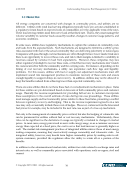
4/20/2020 Understanding Enterprise Risk Management for Utilities © Copyright 2007, CCRO. All rights reserved. 16 2.3.1. Market Risk All energy companies are concerned with changes in commodity prices, and utilities are no different. Utilities with retail load serving obligations typically have pre-set rates established in a regulatory forum based on expected costs of commodities over the applicable term of the rates. These load serving entities must then serve load at that fixed rate. That is, they must manage the volume variability in customer loads caused by weather, changes in customer usage patterns, and economic conditions. In some cases, utilities have regulatory mechanisms to capture the variances in commodity costs and loads from the expected levels. Such mechanisms are designed to minimize a utility’s price risks associated with fuel or the actual commodity they are delivering (electricity or natural gas). Companies with pass-through cost mechanisms are often thought to have lower market risk since there is an opportunity to recover these costs, and risk to their margins is limited to variability in revenues caused by variance in load from expectations. However, these companies may face either regulatory hindsight to recover these costs, or find that recovery mechanisms don’t match the costs incurred for both the commodity and the carrying costs. For instance, depending on the timing of cost recovery mechanisms, a utility can experience cash flow lags and liquidity problems. For this reason, utilities with fuel or supply cost adjustment mechanisms must still implement sound risk management practices to maximize recovery of these costs and ensure enough liquidity to support delays in cost recovery. In addition, utilities may not be allowed to keep the benefits realized from achieving lower than expected commodity costs. There are some utilities that do not have these fuel or cost adjustment mechanisms in place. Rates for those entities are pre-determined based on forecasts of both commodity prices and customer usage. Basically the revenue requirements for providing full service to customers incorporate these assumptions in the overall estimate of rates during rate case proceedings. These utilities must manage supply and fuel commodity prices relative to these fixed rates, presenting a conflict between regulatory recovery and hedging. That is, the revenue requirement agreed to in a rate case may only occasionally include these costs of hedges. However, variances from the forecasted fuel prices for example, may be included in the next rate case as part of a true-up mechanism. Not only is the management of commodity prices critical, but also the hedging of volumetric risk can be paramount for entities without fuel or cost recovery mechanisms. Unfortunately, these risks can be significant as the deviations in usage are typically correlated to changes in market prices. In most cases, energy prices tend to move with energy usage, so as a customer uses more energy than expected at a fixed price, the cost to serve that load increase is generally higher as well. The market risk management practices of integrated utilities mirror those of most energy trading companies, meaning they must actively manage commodity and volumetric risks. An integrated utility, however, may benefit from higher commodity prices by making sales to off- system customers, provided the regulators allow the utility to retain all or a portion of the benefits. In addition to the aforementioned market risks, utilities face risks related to exchange rates and interest rates, as well as commodity prices associated with operations, such as copper, steel and cement.
Purchased by unknown, nofirst nolast
From: CCRO Library (library.ccro.org)