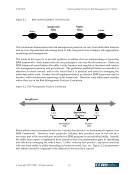
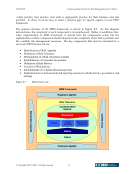
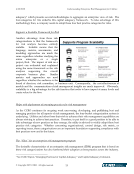
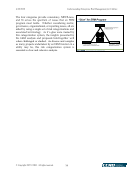
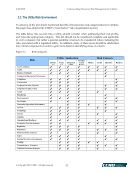
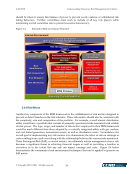
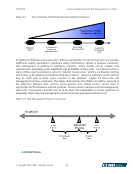
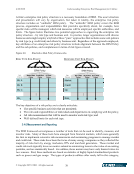
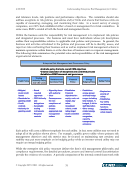
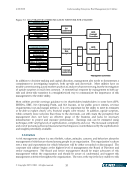
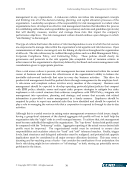
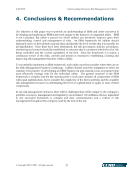
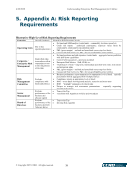
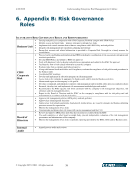
4/20/2020 Understanding Enterprise Risk Management for Utilities © Copyright 2007, CCRO. All rights reserved. 12 certainly preferred. In the case of an unregulated merchant, stakeholders may be shareholders. In the case of a utility, stakeholders may be ratepayers or regulators. Typical stakeholder perspective on market & credit risks is that they are “managed”. This means that they are risks to be taken to some degree to generate a financial return but they must be kept within tolerable limits. The perspective on operative risks is that they are usually to be “mitigated”. This means they are targeted for removal through any number of tools ranging from policies & procedures to insurance. Perspective on business risks is that they are often necessarily “taken”. This means they are inherent to the business at hand yet must be taken judiciously without ignorance, thereby avoiding what can be a rich source of bad surprises. Clearly, using these four risk categories eases alignment of risk measurements and sensible actions to be considered to address those risks. This is very helpful for the risk manager when having a dialog about controls, hedging, capital investments, and other risk related topics with the board of directors or other senior management. Creates Intuitive Risk Aggregations Because risk measurement and assessment approaches and associated tools have come such a long way in the last five years (and will no doubt continue to do so), it is important to be positioned to take advantage of them within your enterprise risk framework. Risk categorizations that are not in line with best practices may cause overlaps or inconsistencies across categories and prevent accurate use of these valuable emerging models. Today, market and credit risks can be measured using a wealth of software tools available that create important measures regarding each individually. Operative risk has become the focus of much work in the financial and energy industry in recent years. In this paper and others, the CCRO has been addressing operative risk for energy companies, especially as a primary component of risk for energy asset operators. The business risk category also is now under study by the CCRO, specifically in terms of how to bring assessment or possible measurements to bear. Through the astute use of the best measurement tools, each of the four buckets can bring powerful insights into the potential impact of risk on company health and performance. However, the greatest challenge may be to create an overall picture of the enterprise and its risk. Much of the challenge comes from difficulty in robust aggregation of all risk categories. The CCRO has done much work to address this challenge in its best practice framework for capital Advancing best practices for today’s competitive energy markets. Highlights Shareholder Perspectives Shareholder Perspective: “manage” these risks “mitigate” these risks “take” these risks wisely Advancing best practices for today’s competitive energy markets. Creates Intuitive Risk Aggregations Actionable insights at many levels Actionable insights Actionable insights at many levels at many levels … or Enterprise Annual Earnings Number of occurrences By bucket…
Purchased by unknown, nofirst nolast
From: CCRO Library (library.ccro.org)