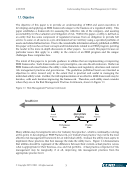
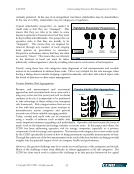
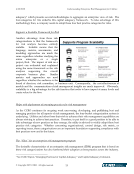
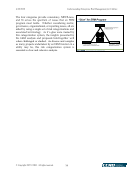
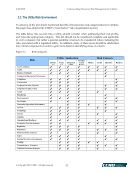
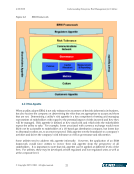
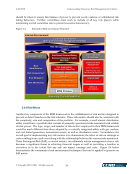
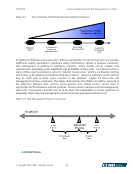
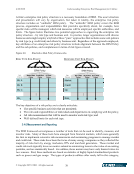
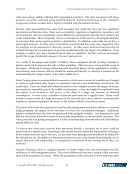
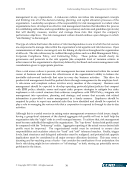
4/20/2020 Understanding Enterprise Risk Management for Utilities © Copyright 2007, CCRO. All rights reserved. 10 of risks. It must do so in order to create clear and cohesive analyses of its risk profile, and to make proposals to effectively address risks according to management needs. Unfortunately, a utility may find itself with inconsistent categories that have simply evolved over the years. Upon close inspection, double-counting may be common, or large gaps may be left from an incomplete categorization system that leaves significant exposures overlooked. Some ways of categorizing risks may be “home grown” and suffer from little buy-in from outsiders that challenge the firm’s understanding of its own risks. In any case, the categorization system chosen by a firm as its standard, are critical to the effectiveness of its risk management program. This section highlights a wealth of past work of the CCRO and its member companies towards developing the most insightful risk categorizations which are today accepted as best practice in the energy industry. Utilities and other energy companies should be aware that adopting these categories for risk is an essential building block towards the most effective risk management function. Though often not recognized as such a critical decision, companies should know that real value can be captured through the astute application of the four risk categories shown at right. Sometimes referred to as four “buckets” of risk, these four categories are used by the leaders in energy risk management today for good reason. The four categories represent the highest level in a system of categorization for risks that utilities, merchants, producers & generators – for that matter – any firm faces to varying degrees. Why have these four buckets of risk so soundly become “best practice”? Answer- because their use brings a substantial list of benefits and advantages. These benefits include those shown as sources of value in the slide at right. These advantages are now well proven by those many energy companies with risk programs in place which utilize this system of categorization. To promote the use of these risk categorizations by energy companies, this section elaborates on a number of these advantages. Alignment with the Financial Industry These four categories or “buckets” are based on those originally developed in a “Corporate Metrics” paper provided as best practice to the financial industry by JP Morgan in 1999. Using that baseline from the financial industry, the CCRO has helped energy companies advance risk practices by further engineering the categories to accommodate the ways the energy industry is unlike the financial industry and its markets. The resulting combination of suitability for energy companies with familiarity for those in the financial industry smoothes the process of delivering Advancing best practices for today’s competitive energy markets. Four Buckets of Risk • CCRO papers advance these four high-level categories that help energy companies build a most insightful enterprise risk management perspective... Overall risk an enterprise faces Overall risk an enterprise faces Advancing best practices for today’s competitive energy markets. Sources of Value from Best Practice Risk Categorizations • Alignment with Financial Industry terminology aides communication • Provides an orderly and exhaustive accounting for risks (MECE) • Highlights shareholder perspectives regarding risks • Creates intuitive risk aggregations • Allows prioritization of risk initiatives • Fosters disciplined EWRM development • Helps with alignment of management responsibility • Supports scalability of risk analysis • Enhances deployment of emerging practices for risk mgt Well-defined risk categorization
Purchased by unknown, nofirst nolast
From: CCRO Library (library.ccro.org)