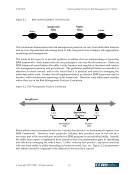
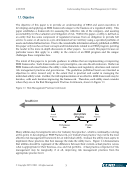
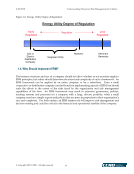
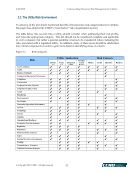
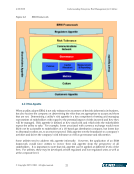
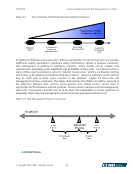
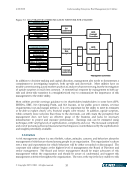
4/20/2020 Understanding Enterprise Risk Management for Utilities © Copyright 2007, CCRO. All rights reserved. 5 1.3. What is a Utility? It is important to define an entity that would be considered a ‘utility’ to focus on the unique nature of the risks faced by such a company. For the purpose of this paper, a utility is defined as an entity that has rates that must be approved by a regulatory authority, be it local, state, regional or federal (including public power’s self-regulating governance), and tends to have extensive exposure to operative risks. Further, this paper focuses only on energy-related utilities that offer products or services to the power and gas sectors. Before proceeding, the various energy-related types of utilities considered in the paper are defined below. • Distribution Company – an independent owner of either gas or electricity distribution infrastructure with the responsibility of delivering the commodity on demand to the end user from the customer’s commodity supplier. • Transmission or Transport Company – an independent transmission or pipeline owner that sells transmission or transport capacity and related services. • Integrated Utility – an entity with the obligation to provide full service to some or all end- users in a pre-determined service territory using a specified portfolio of assets and related infrastructure. • Provider of Last Resort – an entity with the obligation to provide full service at a specified rate for any customer in a pre-defined service territory at the customer’s discretion. While it is true that in a sense all companies report to, or are overseen by a regulatory authority because all companies operate under various laws, this paper focuses on companies that interact with an energy-related regulatory authority. In considering risks facing these utilities, it is important to understand the degree to which these companies are regulated relative to other entities in the energy sector. Specifically, a regulated company operates in an environment in which its rates and effects of decisions are reviewed and approved by a regulatory authority, which affects the company’s operations, investments, and management practices. Ultimately a regulated utility’s returns and thus earnings are highly dependent upon the regulatory authority governing their rates and prudence of operations. Non-regulated companies, while still having regulatory oversight from the FERC to mitigate market power issues, rarely have their returns governed by a regulatory authority. However, regulated companies may also have a non- regulated business unit whose returns may indirectly be affected by regulation. The extent to which companies are regulated can be seen in Figure 1.2 below.
Purchased by unknown, nofirst nolast
From: CCRO Library (library.ccro.org)